Cholesterol
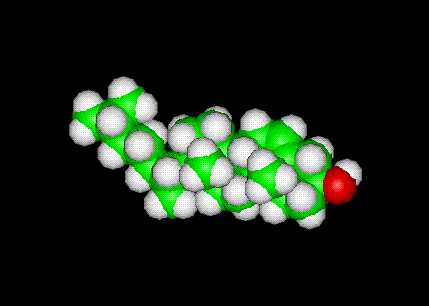
Cholesterol is a sterol (a combination steroid and alcohol) and a lipid found in the cell membranes of all body tissues, and transported in the blood plasma of all animals. Lesser amounts of cholesterol are also found in plant membranes.
The name originates from the Greek chole- (bile) and stereos (solid), and the chemical suffix -ol for an alcohol, as researchers first identified cholesterol in solid form in gallstones in 1784.
Most cholesterol is not dietary in origin; it is synthesized internally. Cholesterol is present in higher concentrations in tissues which either produce more or have more densely-packed membranes, for example, the liver, spinal cord and brain, and also in atheromata. Cholesterol plays a central role in many biochemical processes, but is best known for the association of cardiovascular disease with various lipoprotein cholesterol transport patterns and high levels of cholesterol in the blood.
When doctors talk to their patients about the health concerns of cholesterol, they are often referring to "bad cholesterol", or low-density lipoprotein (LDL). "Good cholesterol" is high-density lipoprotein (HDL); this denotes the way cholesterol is bound in lipoproteins, the natural carrier molecules of the body.
Physical Properties
| Cholesterol | |
|---|---|
| Chemical name | 10,13-dimethyl-17- (6-methylheptan-2-yl)- 2,3,4,7,8,9,11,12,14,15,16,17- dodecahydro-1H- cyclopenta[a]phenanthren-3-ol |
| Chemical formula | C27H46O |
| Molecular mass | 386.65 g/mol |
| CAS number | [57-88-5] |
| Melting point | 146-147 °C |
| SMILES | C[C@H]3C4[C@](CC[C@@H]4 [C@H](C)CCCC(C)C)([H])[C@]2 ([H])CC=C1C[C@@H](O)CC[C@]1 (C)[C@@]2([H])C3 |
| Disclaimer and references | |
Physiology
Function
Cholesterol is required to build and maintain cell membranes; it makes the membrane's fluidity - degree of viscosity - stable over wider temperature intervals (the hydroxyl group on cholesterol interacts with the phosphate head of the membrane, and the bulky steroid and the hydrocarbon chain is embedded in the membrane). Some research indicates that cholesterol may act as an antioxidant.[1] Cholesterol also aids in the manufacture of bile (which helps digest fats), and is also important for the metabolism of fat-soluble vitamins, including vitamins A, D, E and K. It is the major precursor for the synthesis of vitamin D and of the various steroid hormones (which include cortisol and aldosterone in the adrenal glands, and the sex hormones progesterone, the various estrogens, testosterone, and derivatives ).
Recently, cholesterol has also been implicated in cell signalling processes, where it has been suggested that it forms lipid rafts in the plasma membrane. It also reduces the permeability of the plasma membrane to hydrogen ions (protons) and sodium ions.[2]Cholesterol is essential for the structure and function of invaginated caveolae and clathrin-coated pits, including the caveolae-dependent endocytosis and clathrin-dependent endocytosis. The role of cholesterol in caveolae-dependent and clathrin-dependent endocytosis can be investigated by using methyl beta cyclodextrin (MβCD) to remove cholesterol from the plasma membrane.
Body fluids
Cholesterol is minimally soluble in water; it cannot dissolve and travel in the water-based bloodstream. Instead, it is transported in the bloodstream by lipoproteins - protein "molecular-suitcases" that are water-soluble and carry cholesterol and triglycerides internally. The apolipoproteins forming the surface of the given lipoprotein particle determine from what cells cholesterol will be removed and to where it will be supplied.
The largest lipoproteins, which primarily transport fats from the intestinal mucosa to the liver, are called chylomicrons. They carry mostly fats in the form of triglycerides and cholesterol. In the liver, chylomicron particles release triglycerides and some cholesterol, and are converted into low-density lipoprotein (LDL) particles, which carry triglycerides and cholesterol on to other body cells. In healthy individuals the LDL particles are large and relatively few in number. In contrast, large numbers of small dense LDL (sdLDL) particles are strongly associated with promoting atheromatous disease within the arteries. For this reason, LDL is referred to as "bad cholesterol".
The 1987 report of National Cholesterol Education Program, Adult Treatment Panels suggest the total blood cholesterol level should be: <200 mg/dl normal blood cholesterol, 200-239 mg/dl borderline-high, >240 mg/dl high cholesterol.
High-density lipoprotein (HDL) particles transport cholesterol back to the liver for excretion, but vary considerably in their effectiveness for doing this. Having large numbers of large HDL particles correlates with better health outcomes, and hence it is commonly called "good cholesterol". In contrast, having small amounts of large HDL particles is independently associated with atheromatous disease progression within the arteries.
Clinical significance
Hypercholesterolemia
In conditions with elevated concentrations of oxidized L.D.L. particles, especially small LDL particles, cholesterol promotes atheroma formation in the walls of arteries, a condition known as atherosclerosis, which is the principal cause of coronary heart disease and other forms of cardiovascular disease. In contrast, HDL particles (especially large HDL) have been the only identified mechanism by which cholesterol can be removed from atheroma. Increased concentrations of HDL correlate with lower rates of atheroma progressions and even regression.
Of the lipoprotein fractions, LDL, IDL and VLDL are regarded as atherogenic (prone to cause atherosclerosis). Levels of these fractions, rather than the total cholesterol level, correlate with the extent and progress of atherosclerosis. Conversely, the total cholesterol can be within normal limits, yet be made up primarily of small LDL and small HDL particles, under which conditions atheroma growth rates would still be high. In contrast, however, if LDL particle number is low (mostly large particles) and a large percentage of the HDL particles are large, then atheroma growth rates are usually low, even negative, for any given total cholesterol concentration.
These effects are further complicated by the relative concentration of asymmetric dimethylarginine (ADMA) in the endothelium, since ADMA down-regulates production of nitric oxide, a relaxant of the endothelium. Thus, high levels of ADMA, associated with high oxidized levels of LDL pose a heightened risk factor for cardiovascular disease.
Multiple human trials utilizing HMG-CoA reductase inhibitors or statins, have repeatedly confirmed that changing lipoprotein transport patterns from unhealthy to healthier patterns significantly lower cardiovascular disease event rates, even for people with cholesterol values currently considered low for adults; however, no statistically significant mortality benefit has been derived to date by lowering cholesterol using medications in asymptomatic people, i.e., no heart disease, no history of heart attack, etc.
Some of the better-designed recent randomized human outcome trials studying patients with coronary artery disease or its risk equivalents include the Heart Protection Study (HPS), the PROVE-IT trial, and the TNT trial. In addition, there are trials that have looked at the effect of lowering LDL as well as raising HDL and atheroma burden using intravascular ultrasound. Small trials have shown prevention of progression of coronary artery disease and possibly a slight reduction in atheroma burden with successful treatment of an abnormal lipid profile. The American Heart Association provides a set of guidelines for total (fasting) blood cholesterol levels and risk for heart disease:[5]
| Level mg/dL | Level mmol/L | Interpretation |
| <200 | <5.2 | Desirable level corresponding to lower risk for heart disease |
| 200-239 | 5.2-6.2 | Borderline high risk |
| >240 | >6.2 | High risk |
However, as today's testing methods determine LDL ("bad") and HDL ("good") cholesterol separately, this simplistic view has become somewhat outdated. The desirable LDL level is considered to be less than 100 mg/dL (2.6 mmol/L), although a newer target of <70 mg/dL can be considered in higher risk individuals based on some of the above-mentioned trials. A ratio of total cholesterol to HDL another useful measure— of far less than 5:1 is thought to be healthier. Of note, typical LDL values for children before fatty streaks begin to develop is 35 mg/dL.
Patients should be aware that most testing methods for LDL do not actually measure LDL in their blood, much less particle size. For cost reasons, LDL values have long been estimated using the Friedewald formula: [total cholesterol] − [total HDL] − 20% of the triglyceride value = estimated LDL. The basis of this is that Total cholesterol is defined as the sum of HDL, LDL, and VLDL. Ordinarily just the Total, HDL, and Triglycerides are actually measured. The VLDL is estimated as one-fifth of the Triglycerides. It is important to fast for at least 8-12 hours before the blood test because the triglyceride level varies significantly with food intake.
Increasing clinical evidence has strongly supported the greater predictive value of more-sophisticated testing that directly measures both LDL and HDL particle concentrations and size, as opposed to the more usual estimates/measures of the total cholesterol carried within LDL particles or the total HDL concentration.
Hypocholesterolemia
Abnormally low levels of cholesterol are termed hypocholesterolemia. Research into the causes of this state is relatively limited, and while some studies suggest a link with depression, cancer and cerebral hemorrhage it is unclear whether the low cholesterol levels are a cause for these conditions or an epiphenomenon[2].
Food sources
Major dietary cholesterol sources are animal food products. Examples are egg yolk (~1234 mg/g), beef products (~381 mg/g), shrimp products (176 - 256 mg/g) [6]. Plant products (eg. flax seed, peanut), also contain cholesterol-like compounds, phytosterols, which are suggested to help lower serum cholesterol. [7]
Cholesterol in plants
Many sources (including textbooks) incorrectly assert that there is no cholesterol in plants. This misperception is made worse in the United States, where Food and Drug Administration rules allow for cholesterol quantities less than 2 mg/serving to be ignored in labelling. While plant sources contain much less cholesterol (Behrman and Gopalan suggest 50mg/kg of total lipids, as opposed to 5g/kg in animals), they still contain the substance.[8]
References
- Smith LL. Another cholesterol hypothesis: cholesterol as antioxidant. Free Radic Biol Med 1991;11:47-61. PMID 1937129.
- Haines, TH. Do sterols reduce proton and sodium leaks through lipid bilayers? Prog Lipid Res 2001:40:299–324. PMID 11412894.
- a b Anderson RG. Joe Goldstein and Mike Brown: from cholesterol homeostasis to new paradigms in membrane biology. Trends Cell Biol 2003:13:534-9. PMID 14507481.
- Ockene IS, Chiriboga DE, Stanek EJ 3rd, Harmatz MG, Nicolosi R, Saperia G, Well AD, Freedson P, Merriam PA, Reed G, Ma Y, Matthews CE, Hebert JR. Seasonal variation in serum cholesterol levels: treatment implications and possible mechanisms. Arch Intern Med 2004;164:863-70. PMID 15111372.
- "About cholesterol" - American Heart Association
- [1]
- Ostlund RE, Racette, SB, and Stenson WF (2003). "Inhibition of cholesterol absorption by phytosterol-replete wheat germ compared with phytosterol-depleted wheat germ". Am J Clin Nutr 77 (6): 1385-1589.
- Behrman EJ, Gopalan Venkat. Cholesterol and plants. J Chem Educ 2005;82:1791-1793. PDF
Fats in Cooking and Health
- What are the differrent types of fatty acids?
- What are Trans Fats?
- What is the difference between LDL and HDL?
- What are the different types of omega 3 fatty acid?
- What are omega-6 fatty acids?
- The importance of the ratio of omega-6/omega-3 essential fatty acids
- What is the difference between saturated and unsaturated fats?
- What causes oils to go rancid?
- What are essential fatty acids?
- Duck Fat as an alternative to butter
- How to render duck fat
- Did butter get a bad rap?
Types of Fatty Acids
Saturated