Buying and Storing Eggs
Points to Consider
Wholesomeness...grade...size...nutritive value...cost and convenience should be considered when buying eggs.
Wholesomeness
Packers who use USDA's voluntary shell egg grading service have their facilities and procedures federally approved and monitored to ensure that they meet USDA's rigid sanitary requirements. Other packers operate according to State laws.
Nutritive Value
Eggs provide protein, vitamin A, riboflavin, and other vitamins and minerals. The yolk contains all the fat, saturated fat, and cholesterol in an egg. In 1 large egg, the yolk contains 5 grams total fat, 2 grams saturated fatty acids, 213 milligrams cholesterol, and 60 calories. The egg white contains 15 calories. Use the Nutrition Facts panel on each individual product label to learn about the nutrient content of that food and how it fits into an overall daily diet.
Choose a diet low in fat, saturated fat, and cholesterol to help reduce the risk of getting certain diseases and to help maintain a healthy weight. The Dietary Guidelines for Americans suggest choosing a diet containing 30 percent or less of calories from fat, and less than 10 percent of calories from saturated fatty acids. Also, some health authorities suggest that dietary cholesterol be limited to an average of 300 milligrams or less per day.
The Food Guide Pyramid suggests 2 to 3 servings each day of food from the meat group, the equivalent of 5 to 7 ounces of cooked lean meat, poultry, or fish. Because egg protein is of high quality, eggs are an alternative to lean meat, poultry, and fish. Count one whole egg as 1/3 serving, and remember that egg yolks should be limited to four per week.
Tips: Substitute 2 egg whites for each whole egg in muffins, cookies, puddings, and pie fillings. Some specialty egg products are available, such as liquid whole eggs that are lower in fat and cholesterol, liquid products made without yolks, and dried whites for cake decorators. When you choose a whole egg, balance your cholesterol intake by choosing other foods that are low in cholesterol.
Quality and Weight (Size) Assurance
Most eggs are packed according to official U.S. quality grade standards and weight (size) classes. The grade and weight (size) are printed on the egg carton.
The USDA grade shield on the carton means that the eggs were graded for quality and checked for weight (size) under the supervision of a technically trained USDA grader. USDA's grading service is voluntary; egg packers who request it, pay for it. Compliance with grade, weight (size), and sanitary requirements is monitored by USDA.
Egg packers who do not use the USDA grading service will put terms such as "Grade A" on their egg cartons without the shield. Their compliance with grade, weight (size), and other requirements is monitored by State agencies.
Select by Weight (Size)
(U.S. Weight Class)
Size tells you the minimum required net weight per dozen eggs. It does not refer to the dimensions of an egg or how big it looks. Eggs of any weight (size) class may differ in quality. Most published recipes are based on large-size eggs.
| Size or weight class |
Minimum net weight per dozen |
|---|---|
| Jumbo | 30 ounces |
| Extra Large | 27 ounces |
| Large | 24 ounces |
| Medium | 21 ounces |
| Small | 18 ounces |
| Peewee | 15 ounces |
Select by U.S. Grade (Quality)
There are three consumer grades for eggs: U.S. Grade AA, A, and B. The grade is determined by the interior quality of the egg and the appearance and condition of the egg shell. Eggs of any quality grade may differ in weight (size).
U.S. Grade AA eggs have whites that are thick and firm; yolks that are high, round, and practically free from defects; and clean, unbroken shells.
U.S. Grade A eggs have whites that are reasonably firm; yolks that are high, round, and practically free from defects; and clean, unbroken shells. This is the quality most often sold in stores.
U.S. Grade B eggs have whites that may be thinner and yolks that may be wider and flatter than eggs of the higher grades; the shells must be unbroken, but may show slight stains. This quality is seldom found in retail stores.
U.S. Grade AA and A eggs are good for all purposes, but especially for poaching and frying where appearance is important. U.S. Grade B eggs, if available, are fine for general cooking and baking.
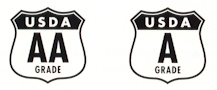 |
| Grade Shields Marks of Quality |
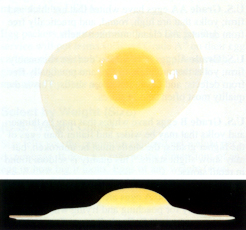 |
| Grade AA eggcovers small area and stands high; white is thick and firm; yolk is high and round. |
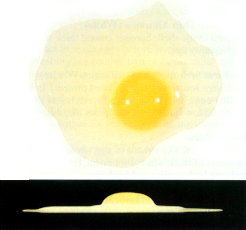 |
| Grade A eggcovers moderate area; white is reasonably firm and stands fairly high; yolk is high. |
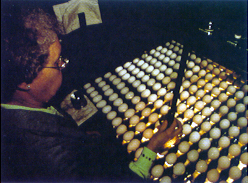 |
| Mass candling-- egg passing over a light. Eggs with cracked shells and interior defects are identified and removed. |
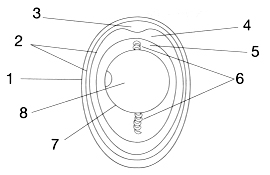
The Parts of an Egg
1 -- Shell
Outer covering of egg, composed mainly of calcium carbonate. May be white or brown depending on breed of chicken. Color does not affect quality, flavor, cooking characteristics, nutritional value, or shell thickness.
2 -- Shell Membranes
Two membranes -- outer and inner -- just inside the shell surrounding the albumen (white). Provide protective barrier against bacterial penetration. Air cell forms between membranes.
3 -- Air Cell
Pocket of air usually found at large end of the egg between shell membranes. Caused by contraction of contents while egg cools after laying. Increases in size with age.
4 -- Outer Thin Albumen (White)
Nearest to the shell. Spreads around thick white of high-quality egg.
5 -- Firm or Inner Thick Albumen (White)
Excellent source of riboflavin and protein. In high-quality eggs, stands higher and spreads less than thin white. In low-quality eggs, appears like thin white.
6 -- Chalazae
Twisted, cord-like strands of egg white. Anchor yolk in center of thick white. Prominent, thick chalazae indicate high quality and freshness.
7 -- Vitelline (Yolk)Membrane
Colorless membrane surrounding yolk.
8 -- Yolk
Yellow portion of egg. Color varies with feed of the hen; does not indicate nutritional content. Major source of vitamins, minerals, almost half of the protein, and all of the fat and cholesterol. Germinal disc; slight depression barely noticeable on side of yolk.
Buying and Storing Tips
Only buy refrigerated eggs with clean, unbroken shells.
It is best not to wash eggs before storing or using them. Washing is a routine part of commercial egg processing and the eggs do not need to be rewashed.
At home, keep raw eggs in their original carton on an inside shelf in the refrigerator (40 °F). For best quality, use within 5 weeks after bringing them home.
Keep hard-cooked eggs (in the shell or peeled) in the refrigerator (40 °F). Use within 1 week after cooking.
Most eggs sold today are infertile; roosters are not housed with the laying hens. Shell color depends on the breed of the hen. Yolk color depends on the feed the hen consumes. There is no nutritional difference between fertile and infertile eggs, brown- and white-shelled eggs, or pale or dark egg yolks.
Safe Handling
Wash hands, utensils, equipment, and work areas with hot, soapy water before and after they come in contact with eggs and egg-containing foods.
Remove only the number of eggs needed from the carton and return the carton to the refrigerator.
Cook eggs until the white is completely firm and the yolk begins to thicken but is not hard. Scrambled eggs should be cooked until no visible liquid remains. Fried eggs should be cooked on both sides or in a covered pan.
Take care when preparing egg-containing foods that are not cooked or are only lightly cooked before serving, such as ice cream, eggnog, mayonnaise, caesar salad, hollandaise sauce, or bearnaise sauce. Only use recipes that start with a stirred egg custard base that is first cooked to 160 °F.
If a recipe calls for adding raw eggs to a previously cooked dish, the dish must be cooked further until it reaches 160 °F.
When preparing any recipe that contains eggs, resist the temptation to taste-test the mixture during preparation. Egg-containing foods should be thoroughly cooked before eating.
When preparing and serving eggs and egg-rich foods, keep them out of the refrigerator no more than 2 hours total, not including cooking time.
If hot egg-rich foods are not going to be served immediately after cooking, put the hot foods into shallow containers and refrigerate at once so they will cool quickly.
For information about egg safety, call USDA's Meat and Poultry Hotline. The national toll-free number is 800-535-4555. In the Washington, DC, area, call (202) 720-3333.
For more information about nutrition, write:
U.S. Department of Agriculture,
Center for Nutrition Policy and Promotion
1120 20th Street NW, Suite 200 North
Washington, DC 20036
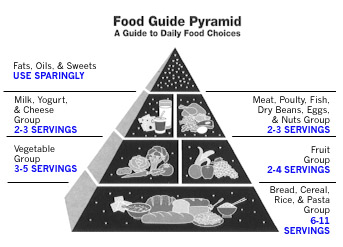
Use the Food Guide Pyramid to help you eat better every day...the Dietary Guidelines way. Start with plenty of Breads, Cereals, Rice, and Pasta; Vegetables; and Fruits. Add two to three servings from the Milk group and two to three servings from the Meat group. Each of these food groups provides some, but not all, of the nutrients you need. No one food group is more important than another - for good health you need them all. Go easy on the fats, oils, and sweets, the foods in the small tip of the Pyramid.
HOW TO BUY EGGS
- Look for the Grade
U.S. Grade AA and U.S. Grade A eggs have whites and yolks that stand high and are practically free from defects, and shells that are clean and unbroken.
- Look for the Size
Size is the required minimum net weight per dozen eggs.
Reference:
HOW TO BUY EGGS
Home and Garden Bulletin No. 144
Agricultural Marketing Service
December 1981
Issue date: February 1995
Science of Cooking with Eggs
Science of Cooking
See also: