Cooking Eggs Sous Vide
See Also: Egg Home Page
If you are beginning to experiment with sous vide cooking, then eggs sous vide is a great place to start. The egg is such a good experimental tool in part because it is composed of the egg white and yolk which each contain proteins which coagulate or harden at different temperatures. For example, the different proteins in the albumen of eggs coagulate at temperatures ranging from 141.8° to 183.2°F (61° to 84°C); just a few degrees difference in cooking temperature will greatly affect just how much the egg white solidifies. While Ovotransferrin begins to set at 140°F/60C, it only comprises 12% of egg white. The major protein of egg white, ovalbumin, makes up 54% of the white and doesn't coagulate until the temperature reaches 80 °C. The yolk begins to thicken around 65 °C and sets around 70 °C.
The yolk proteins begin to thicken at 65 °C and set at 70 °C. Further heating to around 80-90 °C produces the crumbly texture typical of hard boiled eggs. (McGee, Science of Cooking, pp 85) .
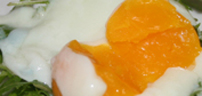
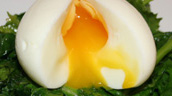
Several chefs have claimed the perfect sous vide egg to be the 65 °C (145°F) egg where both whites and yolk have similar consistencies. We have found in our own tests that eggs still exhibit a runny white while the yolk is more solid at these temperatures (see photos above and below). M
 |
 |
|
Sous Vide egg at 147F (1hr) Runny whites and sem-solid yolk |
Classic 8 minute boiled egg Solid whites and runny yolk |
Egg White Components:
Egg white contains approximately 40 different proteins. Below is a list of major proteins found in egg white by percentage, along with their natural functions.
Ovalbumin 54% Nourishment; blocks digestive enzymes--Begins to set at 180°F/80C
Ovotransferrin 12% Binds iron -- Begins to set at 140°F/60C
Ovomucoid 11% Blocks digestive enzymes
Globulins 8% Plugs defects in membranes, shell
Lysozyme 3.5% Enzyme that digests bacterial cell walls
Ovomucin 1.5% Thickens egg white; inhibits viruses
Avidin .06% Binds vitamin (biotin)
Others 10% Bind vitamins, block digestive enzymes.
Egg Yolk Components:
The two major yolk proteins are lipovitellin (LV) and phosvitin (PV) --(HDL). Lipovitellin is one of the two lipoproteins contained in hen's egg yolk and comprises about one sixth of the yolk solid.
Egg Yolk Composition
Egg yolk is a complex mixture composed of granule and a water soluble fraction, plasma. Each fraction contains a lipoprotein as the main constituent. Granules contain mainly 70% high density lipoprotein (HDL), 16% phosvitin and 12% low-density lipoprotein (LDL). Plasma is composed of 85% LDL and 15% livetin.
| Proteins (16.4%): | Water (48-50%) |
Lipids (32 to 34%) |
| plasma : livetin & LDL (protein content ) | triglycerol (66%) phospholipid (28%) including lecithin (has remarkable emulsifying ability) cholesterol (3%, or 250 mg) | |
| granular fraction: phosvitin (16%, carrier of Fe), lipovitellins (70%) & LDL (12%) | Note: The color of yolk depends on the presence of carotenoids. xanthophylls not carotene (Lutein and zeaxanthin) |
References and Further Reading:
Eggs - Getting Started with Sous-Vide
The Science of Boiling an Egg
Quantitative Analysis of Gelation in Egg Protein Systems
Food Resources --Oregon State -- The Egg
How to prepare the perfect boiled egg
On Food and Cooking -- Harold McGee
The Chicken egg yolk plasma and granule proteomes
Science of Cooking with Eggs
Science of Cooking
See also: