Naked Egg Experiment
| ON DAY 1 BUBBLES OF CARBON DIOXIDE BEGIN TO FORM ON THE EGG SHELL. | 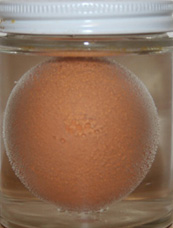 |
|
| ON DAY 7 A TRANSLUCENT EGG IS LEFT AFTER THE SHELL HAS DISSOLVED. | 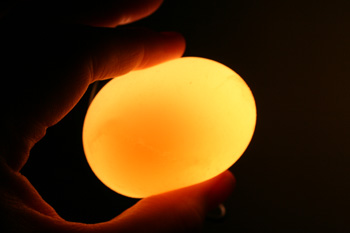 |
|
Here is a classic experiment with eggs. If you soak a raw egg in vinegar, over the course of time, the vinegar will dissolve the eggshell. What you’re left with is the egg’s translucent membrane to protect the egg. Since the shell is made up mostly of calcium carbonate.-- it contains calcium carbonate (94%), magnesium carbonate (1%), calcium phosphate (1%), and 4% organic matter-- vinegar which contains acetic acid will dissolve the shell.
Procedure:
Place the egg in a tall glass or jar and cover the egg with vinegar. Wait a few minutes a look at the jar. You should see bubbles forming on the egg. Leave the egg in the vinegar for a full 24 hours in the refrigerator. After the 24 hours, carefully pour the old vinegar down the drain and cover the egg with fresh vinegar. Place the glass with the vinegar and egg back in the refrigerator for a full week. One week later pour off the vinegar and very carefully rinse the egg with water. The egg looks translucent because the outside shell is gone. Notice that some of the vinegar has permeated through the egg's membrane and caused the egg to get a little bigger.
What happened?
The egg shell is composed of calcium carbonate (CaCO3). When calcium carbonate comes in contact with vinegar which contains acetic acid (CH3CO2H) a chemical reaction occurs.
The first thing that happens is that the carbonate (CO3--) part of calcium carbonate is protonated by acetic acid to make carbonic acid (H2CO3).
Along with this , the calcium and acetate from calcium acetate.
2 CH3COOH + CaCO3 = H2CO3 + Ca(CH3COO)2.
In the next step, the carbonic acid breaks down to form carbon dioxide and water, H2CO3 = H2O + CO2.
The overall reaction is just to sum of the two reactions given,
2 CH3COOH + CaCO3 = H2O + CO2 + Ca(CH3COO)2.
CaCO3(s) + 2CH3COOH(l) Ca(CH3COO)2(s) + H2O(l) + CO2(g) Water and excess vinegar evaporate upon standing. Carbon dioxide (a gas) is released into the air during the reaction.
After you dissolve the eggshell, the egg is surrounded by a membrane. (Actually, it’s two membranes, but they are held tightly together).
What does a naked egg look and feel like? Try it home and see.
Science of Cooking with Eggs
Science of Cooking
See also: