What is the Difference between Saturated and Unsaturated Fats?
Unsaturated vs. Saturated Fats
What are fats and fatty acids?
Fats are a group of chemical compounds that contain fatty acids. Energy is stored in the body mostly in the form of fat. Fat is also needed in the diet to supply essential fatty acids that are substances essential for growth but not produced by the body itself. The terms fat and fatty acids are frequently used interchangeably.
What are the main types of fatty acids?
There are three main types of fatty acids: saturated, monounsaturated and polyunsaturated. All fatty acids are chains of carbon atoms with hydrogen atoms attached to the carbon atoms.
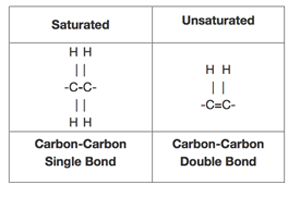
A saturated fatty acid has the maximum possible number of hydrogen atoms attached to every carbon atom. It is therefore said to be "saturated" with hydrogen atoms, and all of the carbons are attached to each other with single bonds.
In some fatty acids, a pair of hydrogen atoms in the middle of a chain is missing, creating a gap that leaves two carbon atoms connected by a double bond rather than a single bond. Because the chain has fewer hydrogen atoms, it is said to be "unsaturated." A fatty acid with one double bond is called "monounsaturated" because it has one gap. Fatty acids having more than one gap are called "polyunsaturated."
The fat in foods contains a mixture of saturated, monounsaturated and polyunsaturated fatty acids. In foods of animal origin, a large proportion of fatty acids are saturated. In contrast, in foods of plant origin and some seafood, a large proportion of the fatty acids are monounsaturated and polyunsaturated. The structure of saturated and unsaturated chemical bonds looks like the diagram below.
Fatty Acids Information
| Saturated | Unsaturated |
| Lauric Acid | Arachidonic Acid |
| Myristic Acid | Omega-3 |
| Palmitic Acid | Omega-7 Palmitoleic Fatty Acid |
| Stearic Acid | Omega-6 |
| Arachidic Acid | Trans Fatty Acids |
| Oleic Acid | |
| Linoleic Acid |
Where are they found?
Saturated fats
Saturated fat is found mostly in foods from animals and some plants.Saturated fats are usually solid at room temperature.
Foods from animals
These include beef, beef fat, veal, lamb, pork, lard, poultry fat, butter, cream, milk, cheeses and other dairy products made from whole milk. These foods also contain dietary cholesterol.
Foods from plants
These include coconut oil, palm oil and palm kernel oil (often called tropical oils), and cocoa butter.
Polyunsaturated and monounsaturated fats
Polyunsaturated and monounsaturated fats are the two unsaturated fats. They're found primarily in oils from plants.
Polyunsaturated fats
These include safflower, sesame and sunflower seeds, corn and soybeans, many nuts and seeds, and their oils. These fats are usually liquid at room temperature and in the refrigerator.
Monounsaturated fats
These include canola, olive and peanut oils, and avocados. These fats remain liquid at room temperature but may start to solidify in the refrigerator.
Can Bad Fats Be Good? Edinformatics takes a look at Omega-7 (Palmitoleic Acid).
Source: CFSAN Office of Nutritional Products, Labeling and Dietary Supplements
|
Fats in Cooking and Health
- What are the differrent types of fatty acids?
- What are Trans Fats?
- What is the difference between LDL and HDL?
- What are the different types of omega 3 fatty acid?
- What are omega-6 fatty acids?
- The importance of the ratio of omega-6/omega-3 essential fatty acids
- What is the difference between saturated and unsaturated fats?
- What causes oils to go rancid?
- What are essential fatty acids?
- Duck Fat as an alternative to butter
- How to render duck fat
- Did butter get a bad rap?
Types of Fatty Acids
Saturated